Alas, the playoff hopes of my real-life favorites are quickly dimming. I also have been too swamped to get too much done in the APBA leagues. I've started the Orioles QL, managing the 1966 edition. I'll post an update on that league once I've gotten through 10 games (right now it's at 7). I haven't started up the NY Giants at all.
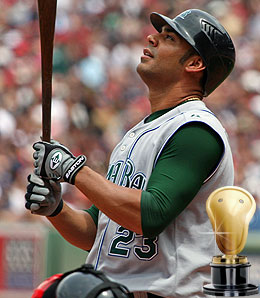
But I figured I'd mark the Rays' clinching of a winning season by officially bumping the 1937 Santo Dominigo Dragones in their favor. With 83 wins and 28 games to play, it seems likely they'll reach 90 wins with no trouble and a .500 record would net them 97. While having the Dragones meant including Satchel Paige, Josh Gibson and other greats in the Cloverland Leagues fun, my general philosophy for the simulation means I should include the team that I have a hope of including at their real relative strength instead of the one with kludged stats. The only real kind of debate would be whether holding off on Tampa Bay until Season 5 might allow a better TB team to be represented, but I can always have a runoff or something if it ends up being useful. But for now, congratulations to Scott Kazmir, Evan Longoria, Carlos Peña and the rest.
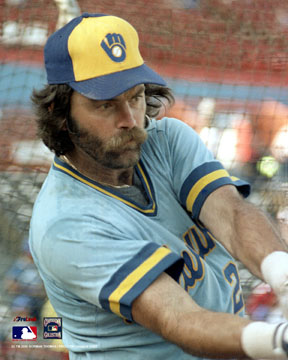
The Brewers present another problem. If the 2008 team is worthy, they could either be stuck in the AL as a non-DH team (since the majority of their seasons were as an AL franchise) or included in the NL (since they would have had this season as an NL team) with the AL version removed, or (gulp) treated as separate teams and included twice (though I don't like that option at all). If treated as an NL team, that would bump the 1896 Orioles and open space in the AL for... well, I guess the Dragones again.
Saturday, August 30, 2008

Tuesday, August 05, 2008
National Heroes
The Washington Nationals Qual League (that'd be the version of the team that moved to Minnesota in 1961) has finished. The 1924 and 1930 teams battled most of the season, with the World Champs opening up a slender lead in the closing weeks...
And then losing it at the very end. As with the Pirates, there were 3-4 rainout makeups to close the season, and it was over the course of those games that the 1930 edition overtook the 1924 team.
The 1930 Nationals finished 2nd in real life to the equally-defunct Philadelphia Athletics, also represented in the Cloverland Leagues. They join a surprising number of 2nd-place teams in a league that ostensibly has the best of each franchise. However, they had the 3rd-most wins in Washington history and the best Pythagorean record of any Washington team, so this result doesn't strain credulity. They were led by Hall of Famer Sam Rice and also had Hall of Famers Joe Cronin and Heinie Manush, trading away HoFer Goose Goslin early in the season. Fittingly for a team managed by Walter Johnson, however, their team strength was pitching. Ironically, in the Qualification League, the 1930 team won via their bats.
Next up: The New York Giants and actually starting the Baltimore Orioles QL.
And then losing it at the very end. As with the Pirates, there were 3-4 rainout makeups to close the season, and it was over the course of those games that the 1930 edition overtook the 1924 team.
The 1930 Nationals finished 2nd in real life to the equally-defunct Philadelphia Athletics, also represented in the Cloverland Leagues. They join a surprising number of 2nd-place teams in a league that ostensibly has the best of each franchise. However, they had the 3rd-most wins in Washington history and the best Pythagorean record of any Washington team, so this result doesn't strain credulity. They were led by Hall of Famer Sam Rice and also had Hall of Famers Joe Cronin and Heinie Manush, trading away HoFer Goose Goslin early in the season. Fittingly for a team managed by Walter Johnson, however, their team strength was pitching. Ironically, in the Qualification League, the 1930 team won via their bats.
Next up: The New York Giants and actually starting the Baltimore Orioles QL.
Sunday, July 13, 2008
A Surprise in Steel City
It came down to the last day, but the 1960 Pittsburgh Pirates will be moving on to Season 4. They finished hot, winning 2/3 of their last 50 games while the 1901 edition played merely OK (.550 over their last 50 games, only about .500 in their last 35). The end of the season saw a slew of rainout make-ups, and the 1960 team finished early, one behind in the loss column but one ahead in wins. Needing to win one game to clinch a tie, the 1901 team instead dropped both of their last make-ups...
So for the first time since I began, Pittsburgh will be represented by a group other than Honus Wagner, Fred Clarke, and their dynasty of the aughts. Given their status as reigning NL East champions, this is also something of a shock. Instead it'll be Roberto Clemente, Vern Law (20-5 in the QL), and Bill Mazeroski.
The Washington Nationals (AL) Qualification League has begun play, with 8 teams from 1912 to 1945. I might put my money on the 1933 team, though the current representatives from 1925 are also a relatively safe bet. Meanwhile, given the play of Tampa Bay and Milwaukee in real life, the odds of an alteration to current expansion plans is certainly a going concern...
So for the first time since I began, Pittsburgh will be represented by a group other than Honus Wagner, Fred Clarke, and their dynasty of the aughts. Given their status as reigning NL East champions, this is also something of a shock. Instead it'll be Roberto Clemente, Vern Law (20-5 in the QL), and Bill Mazeroski.
The Washington Nationals (AL) Qualification League has begun play, with 8 teams from 1912 to 1945. I might put my money on the 1933 team, though the current representatives from 1925 are also a relatively safe bet. Meanwhile, given the play of Tampa Bay and Milwaukee in real life, the odds of an alteration to current expansion plans is certainly a going concern...
Friday, July 11, 2008
50 More Games Gone...
The top of the Pirates League remains the same, though there's been some mixing below that upper crust. The 1901 team still leads, winning at a .646 clip. Bonds and the 1991 Pirates have dropped off the pace from 2nd to 3rd, while the 1960 Pirates are hanging in there, merely 4 games back. Meanwhile, the 1970 team has dropped 2/3 of their games since the last update and now sits in last place, with the 1975 and 1972 teams joining them in freefall. Meanwhile, the 1893 edition has picked up the pace as their best pitchers have been taking the mound more often.
Fred Clarke of 1903 continues to blister the ball, batting .380, but has fallen to 3rd in batting behind 1901's Ginger Beaumont and 1927's Paul Waner, who's up at .407. We'll see if he keeps it up all season. Willie Stargell from 1971 now has the HR lead by himself (25), with two other Stargells, Robertson, and Dr. Strangeglove Dick Stuart rounding out the top 5. Fred Killen of 1893 has 17 wins and leads the league in strikeouts, while Jesse Tannehill from 1902 leads in ERA (1.91).
I'd have to think the 1901 squad would continue their pace and make it to Season 4. The 1960 Pirates were good, but not _that_ good. On the other hand, they only need to get lucky...
Fred Clarke of 1903 continues to blister the ball, batting .380, but has fallen to 3rd in batting behind 1901's Ginger Beaumont and 1927's Paul Waner, who's up at .407. We'll see if he keeps it up all season. Willie Stargell from 1971 now has the HR lead by himself (25), with two other Stargells, Robertson, and Dr. Strangeglove Dick Stuart rounding out the top 5. Fred Killen of 1893 has 17 wins and leads the league in strikeouts, while Jesse Tannehill from 1902 leads in ERA (1.91).
I'd have to think the 1901 squad would continue their pace and make it to Season 4. The 1960 Pirates were good, but not _that_ good. On the other hand, they only need to get lucky...
Friday, June 27, 2008
50 Games Gone in the Steel City
Eighteen teams are vying to represent the Pirates franchise during Season 4. I've gotten through 50 games (out of 136, IIRC). To update all my loyal followers, here's what the top of the standings looks like:
Team W L Pct. GB
1901 35 14 .714 -
1991 32 18 .640 3.5
1960 30 19 .612 5
1909 29 21 .580 6.5
1902 28 22 .560 7.5
1972 26 24 .520 9.5
1975 26 24 .520 9.5
1970 25 25 .500 10.5
I was expecting the 1902 team to be the winners, there's still plenty of time left. The 1991 team is certainly hanging in there, though...
In terms of individual leaders, Fred Clarke of 1903 is leading with a .392 average, Bob Robertson from 1970 and Willie Stargell from 1971 both have 12 home runs, and Jake Beckley form 1893 has 56 RBI. On the pitching side, Vern Law and Bob Friend of the 1960 team and Deacon Phillipe from 1901 all have 8 wins. Ed Brandt from 1938 has an ERA of 1.13 (though he's unlikely to get enough innings over the whole season to qualify), and 1902's Jack Chesbro leads with 60 strikeouts.
Team W L Pct. GB
1901 35 14 .714 -
1991 32 18 .640 3.5
1960 30 19 .612 5
1909 29 21 .580 6.5
1902 28 22 .560 7.5
1972 26 24 .520 9.5
1975 26 24 .520 9.5
1970 25 25 .500 10.5
I was expecting the 1902 team to be the winners, there's still plenty of time left. The 1991 team is certainly hanging in there, though...
In terms of individual leaders, Fred Clarke of 1903 is leading with a .392 average, Bob Robertson from 1970 and Willie Stargell from 1971 both have 12 home runs, and Jake Beckley form 1893 has 56 RBI. On the pitching side, Vern Law and Bob Friend of the 1960 team and Deacon Phillipe from 1901 all have 8 wins. Ed Brandt from 1938 has an ERA of 1.13 (though he's unlikely to get enough innings over the whole season to qualify), and 1902's Jack Chesbro leads with 60 strikeouts.
Sunday, June 15, 2008
Royals Treatment and Incoming Pirates
Congratulations to the 1977 Kansas City Royals, which will (eventually) represent the franchise in Season 4 of the Cloverland Leagues. They ended up crushing their rivals in a four-team league, going 100-56 and 24.5 games ahead of the second-place 1978 edition.
Next up: A truly massive 18-team Pittsburgh Pirates QL. The participants range from an 1893 team that featured Connie Mack as a player, through the Honus Wagner years, Roberto Clemente, and Willie Stargell years all the way down to teams with a young Barry Bonds. My guess is that the 1902 team, current NL East champions, will take it and return for Season 4.
I also may start trying to get the Baltimore Orioles QL underway. I plan to manage one of those teams, though, and I'm having a hard time picking...
Next up: A truly massive 18-team Pittsburgh Pirates QL. The participants range from an 1893 team that featured Connie Mack as a player, through the Honus Wagner years, Roberto Clemente, and Willie Stargell years all the way down to teams with a young Barry Bonds. My guess is that the 1902 team, current NL East champions, will take it and return for Season 4.
I also may start trying to get the Baltimore Orioles QL underway. I plan to manage one of those teams, though, and I'm having a hard time picking...
Sunday, June 01, 2008
Photo Finish (and a reshoot)
The Royals Qualification League reached a finish, with the top three teams extremely tightly bunched:
W L Pct. GB
KC 1978 92 70 .568 -
KC 1976 91 71 .562 1
KC 1977 91 71 .562 1
The three teams were also closely matched to one another, within 2 games of .500 over 36 games played. Statistically, they were also very close in ERA and fielding, though the 1977 team scored significantly more runs than their rivals... They also were much better in real life.
So, I figured I'd run it all again, this time with just those three teams and the incumbent 1985 team, which finished fifth (though only a half-game out of fourth). I'm roughly halfway through there, and they're not bunched. So I'm confident there will be a clear-cut Best Royals Team. :)
W L Pct. GB
KC 1978 92 70 .568 -
KC 1976 91 71 .562 1
KC 1977 91 71 .562 1
The three teams were also closely matched to one another, within 2 games of .500 over 36 games played. Statistically, they were also very close in ERA and fielding, though the 1977 team scored significantly more runs than their rivals... They also were much better in real life.
So, I figured I'd run it all again, this time with just those three teams and the incumbent 1985 team, which finished fifth (though only a half-game out of fourth). I'm roughly halfway through there, and they're not bunched. So I'm confident there will be a clear-cut Best Royals Team. :)
Sunday, May 18, 2008
KC Update
Things have been poking along slowly around the Pleasure Grounds, but the Royals Qualification League has slowly been moving forward. With about 6 weeks of game time to go, the top of the standings look like:
Team W L Pct. GB
KC 1977 73 55 .570 -
KC 1976 71 54 .568 .5
KC 1978 72 55 .567 .5
KC 1985 70 55 .560 1.5
KC 1984 65 64 .504 8.5
The 1980 team is further back, but it at least seems clear that the mid-late 70s teams were the best in Royals history. Not that this is a surprise.
Team W L Pct. GB
KC 1977 73 55 .570 -
KC 1976 71 54 .568 .5
KC 1978 72 55 .567 .5
KC 1985 70 55 .560 1.5
KC 1984 65 64 .504 8.5
The 1980 team is further back, but it at least seems clear that the mid-late 70s teams were the best in Royals history. Not that this is a surprise.
Saturday, April 05, 2008
Good Morning Baltimore!
I'm going to run most of the qualification leagues with all computer managers, which'll speed things up. But for two of the leagues I'm interested enough to actually manage one team for myself: the Red Sox and the Orioles. Since the local boys aren't going to threaten this year, it seems safe enough to do them first (I'd just as soon hold off on Boston since there's the chance the 2008 team will be the "best-ever" team, though i dearly hope they're not).
I've got 14 teams lined up for the Orioles League, split into two divisions: 6 in the pre-DH division, 8 in the DH division. As with the other QLs, there are basically three types of teams: pennant winners/playoff teams, close misses, and good teams that may or may not have come _that_ close but represent an otherwise absent era. The Orioles were excellent for most of the 70s and early 80s, with a brief late 90s renaissance. In addition, there are 4 teams included from the 1960s-- the 1969 team (famous for losing to the Mets), the 1966 World Series winners, and two near-miss teams, 1960 and 1964. I left out the 1996 wild-card winners since they clearly don't match up and (perhaps more to the point), it'd be a _lot_ more work to include them than other teams since I'd have to enter all their players in by hand.
I haven't totally decided, but I'm leaning toward managing either the 1966 or 1979 teams.
In other QL news, at about the 1/3 mark, the 1985 Royals hold a slim lead over the 1980 team, with 1978 and 1977 close behind. The 1985 Royals are the current Cloverland League representative.
I've got 14 teams lined up for the Orioles League, split into two divisions: 6 in the pre-DH division, 8 in the DH division. As with the other QLs, there are basically three types of teams: pennant winners/playoff teams, close misses, and good teams that may or may not have come _that_ close but represent an otherwise absent era. The Orioles were excellent for most of the 70s and early 80s, with a brief late 90s renaissance. In addition, there are 4 teams included from the 1960s-- the 1969 team (famous for losing to the Mets), the 1966 World Series winners, and two near-miss teams, 1960 and 1964. I left out the 1996 wild-card winners since they clearly don't match up and (perhaps more to the point), it'd be a _lot_ more work to include them than other teams since I'd have to enter all their players in by hand.
I haven't totally decided, but I'm leaning toward managing either the 1966 or 1979 teams.
In other QL news, at about the 1/3 mark, the 1985 Royals hold a slim lead over the 1980 team, with 1978 and 1977 close behind. The 1985 Royals are the current Cloverland League representative.
Thursday, April 03, 2008
Season Zero
While I've played a few seasons now with Baseball for Windows (ironically using Virtual PC on my Apple), the very first season was with a Strat-O-Matic card set. I've been thinking of it as Season Zero.
I started it not long after the 1981 baseball strike, when I bought my Strat-O-Matic set. The setup seemed reasonable to me, 11-year-old that I was when I started: use the original 16 teams and play out a season. Unfortunately, given the limitations of the available card sets (and my losing track), I ended up with the Milwaukee Braves instead of the Boston Braves. I also had to settle for the 1940 Reds and the 1950 Phillies instead of the Big Red Machine or the 1980 Philadelphia World Series winners...
I set up an 84-game schedule, and I kept stats by hand. It took years, but luckily I didn't have much of a life (I was, after all, 11-14). I also didn't necessarily follow all the rules: I was too lazy to reshuffle the 40-card deck after every draw, which I'd do for a truly random number. So that got a bit biased. I also didn't necessarily use the "right" lineups, and I'd often turn a good part-time hitter into a full-timer (Fred McNeely, '24 Nationals-- I'm looking at you). But eventually I got through it all.
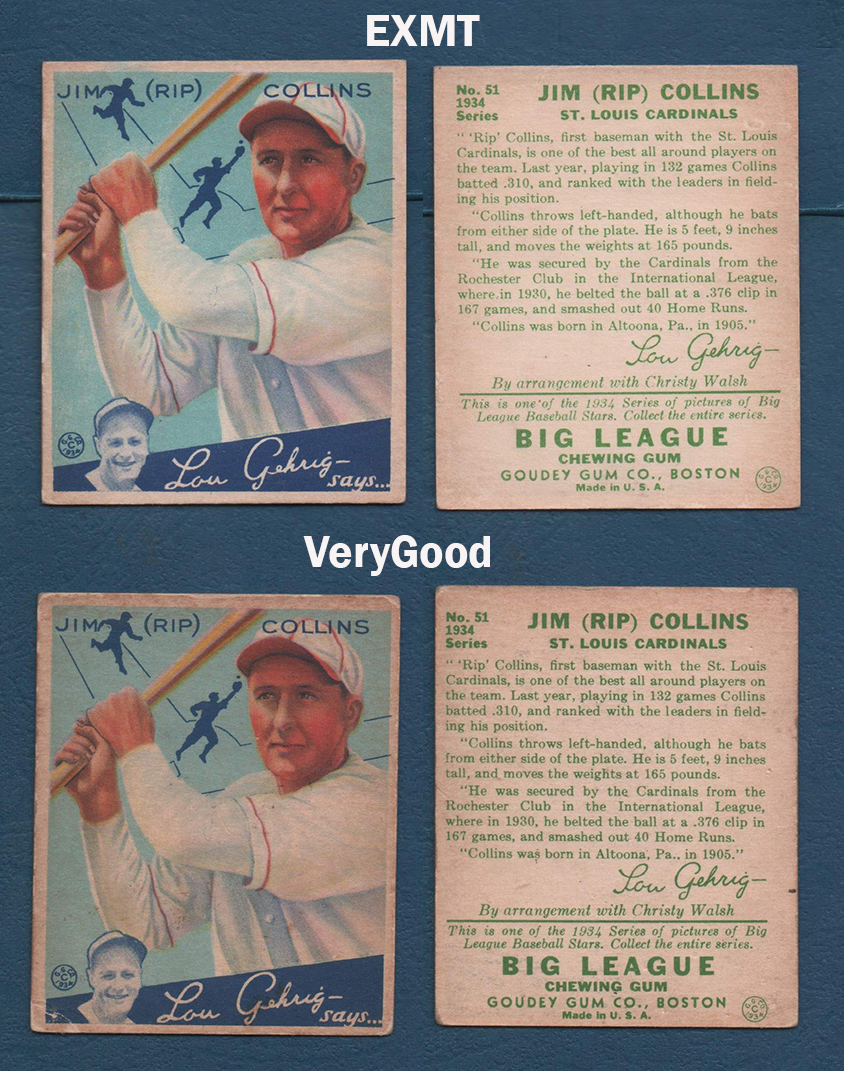
The '27 Yankees ran away with the American League, leaving the '31 A's in the dust. The '53 Brooklyn Dodgers tussled with those underdog Reds and Phils all season, finally pulling it out by one game over Cincinnati and two over Philadelphia. The Yanks defeated Brooklyn in six games. Lou Gehrig was the MVP for the AL. I don't remember the NL winner, Rip Collins of the '34 Cardinals, perhaps?
These teams and this setup provided the basis for Season 1, though with the software I was able to substitute in a Boston Braves team and also get the Big Red Machine and... well, whatever you'd call the 1980 Phillies.
I started it not long after the 1981 baseball strike, when I bought my Strat-O-Matic set. The setup seemed reasonable to me, 11-year-old that I was when I started: use the original 16 teams and play out a season. Unfortunately, given the limitations of the available card sets (and my losing track), I ended up with the Milwaukee Braves instead of the Boston Braves. I also had to settle for the 1940 Reds and the 1950 Phillies instead of the Big Red Machine or the 1980 Philadelphia World Series winners...
I set up an 84-game schedule, and I kept stats by hand. It took years, but luckily I didn't have much of a life (I was, after all, 11-14). I also didn't necessarily follow all the rules: I was too lazy to reshuffle the 40-card deck after every draw, which I'd do for a truly random number. So that got a bit biased. I also didn't necessarily use the "right" lineups, and I'd often turn a good part-time hitter into a full-timer (Fred McNeely, '24 Nationals-- I'm looking at you). But eventually I got through it all.
The '27 Yankees ran away with the American League, leaving the '31 A's in the dust. The '53 Brooklyn Dodgers tussled with those underdog Reds and Phils all season, finally pulling it out by one game over Cincinnati and two over Philadelphia. The Yanks defeated Brooklyn in six games. Lou Gehrig was the MVP for the AL. I don't remember the NL winner, Rip Collins of the '34 Cardinals, perhaps?
These teams and this setup provided the basis for Season 1, though with the software I was able to substitute in a Boston Braves team and also get the Big Red Machine and... well, whatever you'd call the 1980 Phillies.
Wednesday, March 26, 2008
Milwaukee's Best
During the no doubt too-long interim between Season 3 and Season 4, everything does not cease. No, indeed! I've been starting to run qualification leagues (for lack of a better term) to try and objectively (sort of) determine which teams get to represent the franchises. The expansion teams have already been figured out, as seen in an earlier post. The first of the currently-in franchises to go through a QL are the Milwaukee Braves.
The Braves were a good team through most of their sojourn in Milwaukee, and an excellent team for much of the time. In their 14 or so years between Boston and Atlanta, they won two pennants and one World Series, and tied for first place one more time (losing in a playoff), never finishing under .500. I picked 6 teams for this league, the pennant winners ('57 and '58) and near miss team ('59), and a set of second-place teams ('53, '56, and '60).
And to my surprise, it was the 1953 team that won it. I ran the league twice through 140-game seasons, with them winning once running away and once in a squeaker. In real life they finished a poor second to a juggernaut Brooklyn team, but with 92 wins. Their Pythagorean record was slightly better (93-61), even with the 1957 and 1958 pennant winners.
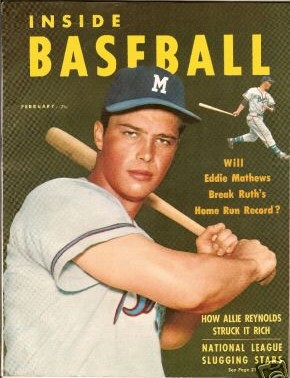
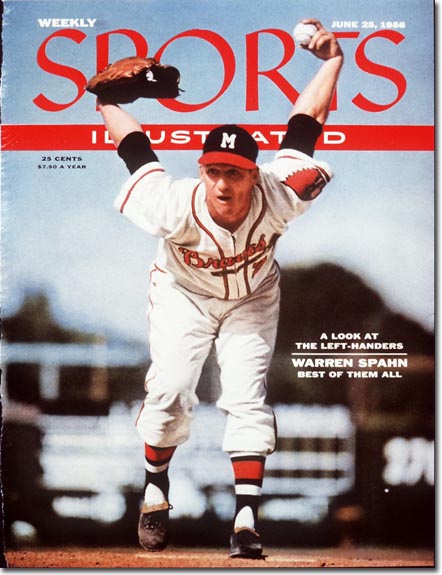
But in some kind of reverse Ewing Theory, the 1953 team is the only one without Hank Aaron. They did have big seasons from Eddie Mathews and Warren Spahn, however.
The Kansas City Royals qualification league is now underway. My breath is somewhat bated.
The Braves were a good team through most of their sojourn in Milwaukee, and an excellent team for much of the time. In their 14 or so years between Boston and Atlanta, they won two pennants and one World Series, and tied for first place one more time (losing in a playoff), never finishing under .500. I picked 6 teams for this league, the pennant winners ('57 and '58) and near miss team ('59), and a set of second-place teams ('53, '56, and '60).
And to my surprise, it was the 1953 team that won it. I ran the league twice through 140-game seasons, with them winning once running away and once in a squeaker. In real life they finished a poor second to a juggernaut Brooklyn team, but with 92 wins. Their Pythagorean record was slightly better (93-61), even with the 1957 and 1958 pennant winners.
But in some kind of reverse Ewing Theory, the 1953 team is the only one without Hank Aaron. They did have big seasons from Eddie Mathews and Warren Spahn, however.
The Kansas City Royals qualification league is now underway. My breath is somewhat bated.
Thursday, February 07, 2008
MVP Awards
Unlike the Cy Young awards, the MVP awards came out a bit surprisingly, particularly in the AL. I don't know if "real life" voters would have gone this way, but the differences in VORP were too big to ignore...
NL- Dolph Camilli: This was a two-man race much of the year, Camilli vs. Barry Bonds. Dolph led the NL in VORP and was at or near the top in most of the more traditional categories-- 2nd in batting average (.335, Ginger Beaumont led at .339), 2nd in slugging average (.633, Bonds was at .662), leading in on-base percentage (.442) and RBI (127, tied with Hank Aaron). He also hit 37 home runs (4th, Bonds led with 50). By most sabermetric measures Camilli and Bonds were equals, so the tie-breaker was the pennant race where Dolph led Brooklyn to a close 2nd place finish vs. the 6th place finish San Francisco had.
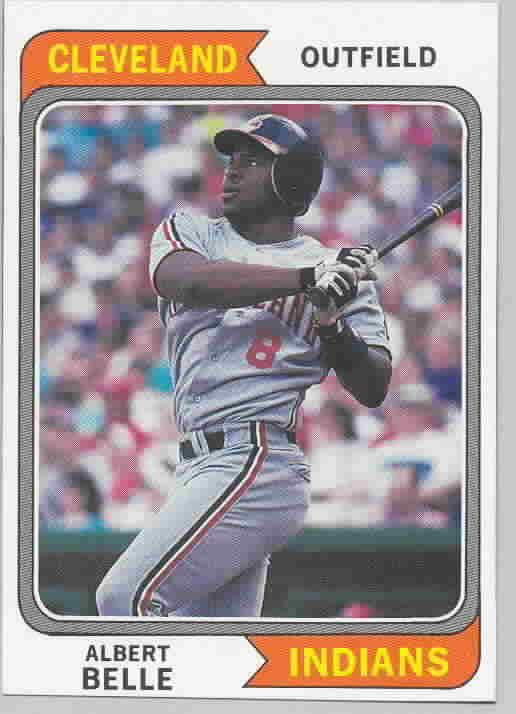
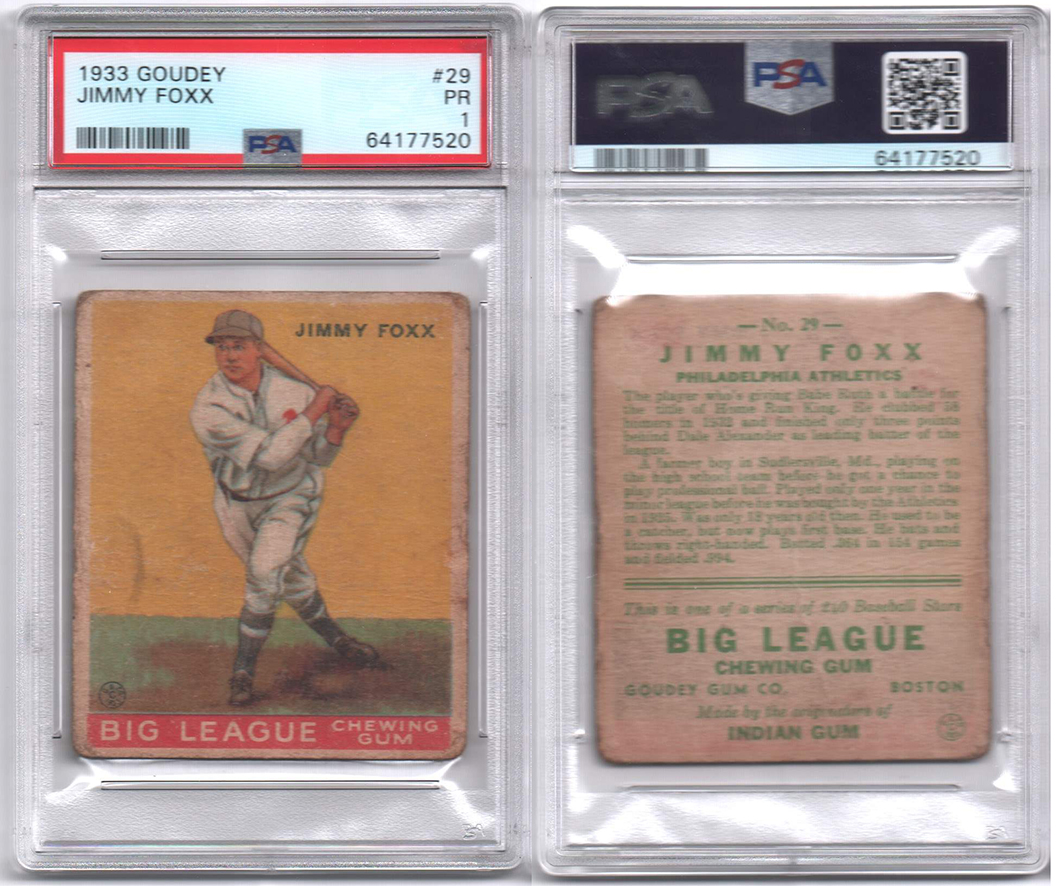
AL- George Sisler: I'm actually as surprised as you are. Of course, you're probably me if you're reading this. :) Albert Belle had a truly monstrous first half, and was a critical part of an Indians team that needed every contribution they got to eke out a division title over the Mariners, an ALCS win over the Yankees, and a 7-game Cloverland Series championship over the Cubs. Plus, he had 62 home runs and 138 RBI! Still, he placed a surprisingly low 5th in VORP. Of those ahead of him, Tris Speaker edged him out in VORP by placing well in many categories. Better yet were a pair of Philadelphia Athletics who put in huge years: Jimmy Foxx was 5th in slugging (.601, Belle led with .698), 4th in OBP (.423), and also in the top 10 in runs, RBI, doubles and triples. Al Simmons was better yet, finishing 2nd in batting (.374) and slugging (.674), leading the league in RBI (149), tied for third in triples (21, Gardner and Goslin led the league with 22) and in the top 10 in runs, OBP, runs, hits, and home runs. Any other year, Simmons would have been the winner.
But this season George Sisler hit .434. Now, I know there's some amount of disbelief that needs to be suspended here. And I know there's no way in the world Sisler hits .434 against the competition he had. Nobody has ever hit .434 for real even facing awful teams. But there it is- he hit .434 and given that and his other statistics (4th in slugging, 1st in OBP, leading in hits, top 10 in runs, RBI, and stolen bases), and that he led in VORP by 20 runs I don't see any rational way to deny he had the best season of anyone. Cleveland fans may argue, but I think the logic is irrefutable. So congratulations to the Browns fans!
NL- Dolph Camilli: This was a two-man race much of the year, Camilli vs. Barry Bonds. Dolph led the NL in VORP and was at or near the top in most of the more traditional categories-- 2nd in batting average (.335, Ginger Beaumont led at .339), 2nd in slugging average (.633, Bonds was at .662), leading in on-base percentage (.442) and RBI (127, tied with Hank Aaron). He also hit 37 home runs (4th, Bonds led with 50). By most sabermetric measures Camilli and Bonds were equals, so the tie-breaker was the pennant race where Dolph led Brooklyn to a close 2nd place finish vs. the 6th place finish San Francisco had.
AL- George Sisler: I'm actually as surprised as you are. Of course, you're probably me if you're reading this. :) Albert Belle had a truly monstrous first half, and was a critical part of an Indians team that needed every contribution they got to eke out a division title over the Mariners, an ALCS win over the Yankees, and a 7-game Cloverland Series championship over the Cubs. Plus, he had 62 home runs and 138 RBI! Still, he placed a surprisingly low 5th in VORP. Of those ahead of him, Tris Speaker edged him out in VORP by placing well in many categories. Better yet were a pair of Philadelphia Athletics who put in huge years: Jimmy Foxx was 5th in slugging (.601, Belle led with .698), 4th in OBP (.423), and also in the top 10 in runs, RBI, doubles and triples. Al Simmons was better yet, finishing 2nd in batting (.374) and slugging (.674), leading the league in RBI (149), tied for third in triples (21, Gardner and Goslin led the league with 22) and in the top 10 in runs, OBP, runs, hits, and home runs. Any other year, Simmons would have been the winner.
But this season George Sisler hit .434. Now, I know there's some amount of disbelief that needs to be suspended here. And I know there's no way in the world Sisler hits .434 against the competition he had. Nobody has ever hit .434 for real even facing awful teams. But there it is- he hit .434 and given that and his other statistics (4th in slugging, 1st in OBP, leading in hits, top 10 in runs, RBI, and stolen bases), and that he led in VORP by 20 runs I don't see any rational way to deny he had the best season of anyone. Cleveland fans may argue, but I think the logic is irrefutable. So congratulations to the Browns fans!
Saturday, February 02, 2008
Cy Young Awards
Naturally, statistics are kept in the Cloverland Leagues. And naturally, awards are given. However, I get the only vote. :) I actually went to the trouble of determining VORP for all the players, and rely pretty heavily on that statistic, though I'm willing to use other info as appropriate. The Cy Young awards for the Cloverland Leagues this season have two relatively obvious winners.
AL: Lefty Grove. While the Philadelphia Athletics had a disappointing season (under .500 and tied for last in the AL Classic Division) Grove provided a bright spot, leading the league in wins (22), ERA (2.40), and shutouts (6, tied with the Yankees' Red Ruffing) while coming in second in strikouts and leading Philadelphia in saves. Baltimore's Jim Palmer was quite close, also winning 20 games with a better winning percentage and more quality starts, along with pitching in a pennant race, but Grove's across the board excellence gained him the nod.
NL: Ed Reulbach. Unlike Grove, Reulbach did not lead a lot of categories-- Kid Nichols (among others) had many more starts and unsuprisingly racked up the counting stats (Nichols led the league with 27, Don Sutton led the league in strikeouts). Reulbach did, however, run away with the ERA crown, finishing with 1.41 in 243 innings, nearly 2 runs better than the league average. He also finished second in shutouts (6, Mordecai Brown led the league with 8) and held opponents to a .164 batting average, way below the league average of .243 and by far the best for pitchers over 100 innings let alone over 200 innings. He held opponents to an average of 5 hits per game and allowed an astonishing 0.04 home runs per game, the league leader by a factor of 5. He pitched 6 two-hitters and a 1-hitter, single-handedly accounting for half of the Cubs number of two-hitters or better. Although not taken into account for these purposes, Reulbach continued to excel in the postseason, finishing 5-0 with 5 quality starts in 5 tries and an ERA of 0.63 as the Cubs almost won the Series. There was no particularly strong competition for this award, Brown was second in VORP but was only the second-best pitcher on the Cubs...
AL: Lefty Grove. While the Philadelphia Athletics had a disappointing season (under .500 and tied for last in the AL Classic Division) Grove provided a bright spot, leading the league in wins (22), ERA (2.40), and shutouts (6, tied with the Yankees' Red Ruffing) while coming in second in strikouts and leading Philadelphia in saves. Baltimore's Jim Palmer was quite close, also winning 20 games with a better winning percentage and more quality starts, along with pitching in a pennant race, but Grove's across the board excellence gained him the nod.
NL: Ed Reulbach. Unlike Grove, Reulbach did not lead a lot of categories-- Kid Nichols (among others) had many more starts and unsuprisingly racked up the counting stats (Nichols led the league with 27, Don Sutton led the league in strikeouts). Reulbach did, however, run away with the ERA crown, finishing with 1.41 in 243 innings, nearly 2 runs better than the league average. He also finished second in shutouts (6, Mordecai Brown led the league with 8) and held opponents to a .164 batting average, way below the league average of .243 and by far the best for pitchers over 100 innings let alone over 200 innings. He held opponents to an average of 5 hits per game and allowed an astonishing 0.04 home runs per game, the league leader by a factor of 5. He pitched 6 two-hitters and a 1-hitter, single-handedly accounting for half of the Cubs number of two-hitters or better. Although not taken into account for these purposes, Reulbach continued to excel in the postseason, finishing 5-0 with 5 quality starts in 5 tries and an ERA of 0.63 as the Cubs almost won the Series. There was no particularly strong competition for this award, Brown was second in VORP but was only the second-best pitcher on the Cubs...
Sunday, January 20, 2008
One curse ended/One curse continued: Game 7
Cleveland! Chicago! Game 7!
Two of the greatest teams in baseball history face off to determine the winner of the Cloverland League championship. Neither won the World Series in reality, each franchise represents the longest championship drought in their league.
Taking the hill for the Indians was El Presidente, Dennis Martinez, while the Cubs countered with Jack Pfiester. The Jake was packed and raucous as "Hometown Hero" Bob Feller, a member of the 1948 champion Indians, threw out the ceremonial first pitch to Hall of Famer Earl Averill.
As has been the pattern through the series, the pitchers worked quickly through the first three innings. The Cubs broke through in the top of the 4th as the Peerless Leader, Frank Chance, manufactured a run on a single and stolen base, moving to third on a ground out and scoring on another ground out.
Pfiester looked like he would make that run count, retiring Cleveland without a run through the 5th. The sixth inning began with trouble, as Tony Peña doubled. The next three batters all hit the ball hard, climaxed by Carlos Baerga's clout to deep left, but all went at fielders save Baerga's (on which Slagle made a brilliant play, stealing a homer). Pfiester escaped the 6th with a 1-0 lead, but perhaps the Indians were catching up with him? The answer came after Martinez pitched a scoreless 7th.
AL MVP candidate Albert Belle had been having a pretty quiet series, but led off the 7th with a double. Jim Thome, whose series had been even more quiet, followed that up with an RBI double, and as quickly as that the Cubs lead was gone. After a strike out of Eddie Murray, and an intentional walk to the ubiquitous Manny Ramirez, pinch hitter Herbert Perry hit a comebacker to Pfiester that was just too slow to be a double play, extending the inning. Pinch hitter Sandy Alomar took advantage, singling to center and scoring Thome. 2-1 Cleveland. Carl Lundgren ended the inning without further damage, but Chicago, 6 outs away from winning the championship, was now 6 outs away from losing it.
Dennis Martinez gave way in the 8th after allowing only three hits and the one run to the Cubs. Assenmacher and Plunk shut down Chicago in the top of the 8th, the rapidly-heating Thome added an insurance run in the form of a homer off of Lundgren.
The Cleveland crowd went wild as Jose Mesa took the mound in search of his third save, to close out the Series. Unfortunately for them, this was Jose Mesa. Sheckard led off with a single and took second on fielder's indifference. With one out Chance walked, now representing the tying run with Steinfeldt and Schulte coming up. Mesa bore down, however and retired both, Schulte's popup to Baerga sealing the deal and making the 1995 Cleveland Indians the champions of the Cloverland League's Third Season.
Two of the greatest teams in baseball history face off to determine the winner of the Cloverland League championship. Neither won the World Series in reality, each franchise represents the longest championship drought in their league.
Taking the hill for the Indians was El Presidente, Dennis Martinez, while the Cubs countered with Jack Pfiester. The Jake was packed and raucous as "Hometown Hero" Bob Feller, a member of the 1948 champion Indians, threw out the ceremonial first pitch to Hall of Famer Earl Averill.
As has been the pattern through the series, the pitchers worked quickly through the first three innings. The Cubs broke through in the top of the 4th as the Peerless Leader, Frank Chance, manufactured a run on a single and stolen base, moving to third on a ground out and scoring on another ground out.
Pfiester looked like he would make that run count, retiring Cleveland without a run through the 5th. The sixth inning began with trouble, as Tony Peña doubled. The next three batters all hit the ball hard, climaxed by Carlos Baerga's clout to deep left, but all went at fielders save Baerga's (on which Slagle made a brilliant play, stealing a homer). Pfiester escaped the 6th with a 1-0 lead, but perhaps the Indians were catching up with him? The answer came after Martinez pitched a scoreless 7th.
AL MVP candidate Albert Belle had been having a pretty quiet series, but led off the 7th with a double. Jim Thome, whose series had been even more quiet, followed that up with an RBI double, and as quickly as that the Cubs lead was gone. After a strike out of Eddie Murray, and an intentional walk to the ubiquitous Manny Ramirez, pinch hitter Herbert Perry hit a comebacker to Pfiester that was just too slow to be a double play, extending the inning. Pinch hitter Sandy Alomar took advantage, singling to center and scoring Thome. 2-1 Cleveland. Carl Lundgren ended the inning without further damage, but Chicago, 6 outs away from winning the championship, was now 6 outs away from losing it.
Dennis Martinez gave way in the 8th after allowing only three hits and the one run to the Cubs. Assenmacher and Plunk shut down Chicago in the top of the 8th, the rapidly-heating Thome added an insurance run in the form of a homer off of Lundgren.
The Cleveland crowd went wild as Jose Mesa took the mound in search of his third save, to close out the Series. Unfortunately for them, this was Jose Mesa. Sheckard led off with a single and took second on fielder's indifference. With one out Chance walked, now representing the tying run with Steinfeldt and Schulte coming up. Mesa bore down, however and retired both, Schulte's popup to Baerga sealing the deal and making the 1995 Cleveland Indians the champions of the Cloverland League's Third Season.
Saturday, December 29, 2007
Championship Series, Game 6
The action switched back to Cleveland for Game 6. As expected, Ed Reulbach got the call for the Cubs in this must-win situation. The Indians opted to hold Dennis Martinez for Game 7 and trust in Charles Nagy to try and bring the Cloverland League championship to the Forest City.
The game was a taut one through 5. Chicago scratched out a run in the 2nd on a single by Johnny Kling (who took 2nd on a misplay by Manny Ramirez), a sacrifice by Frank Schulte, and a bloop single by Johnny Evers. The Indians threatened in the bottom of the inning, putting men on 2nd and 3rd with one out before Ramirez grounded hard to Tinker and Sorrento ended the inning with a strikeout.
Nagy ran into more trouble in the 6th, walking Steinfeldt to open the inning, who came around to score on a single by Schulte after a fielder's choice. Nagy again escaped without further damage thanks to yet another baserunner kill by Manny, who nailed Schulte at the plate after a single by Slagle to end the inning.
Nagy gave way to Alan Embree in the 7th, and Embree made the Indians' job much harder by walking the two men he faced, loading the bases. Julian Tavarez made matters that much worse by hitting Chance to drive in a run, giving up a single to Steinfeldt, and walking Kling before giving way himself to Assenmacher. One fielder's choice and one double play later, Cleveland had escaped, but with a 6-0 deficit.
Overall entered in the 8th and kept Cleveland down as the Cubs added another run off of Ken Hill in the 9th. In the end, Chicago held the Indians to 4 hits, setting up a climactic Game 7!
Carl Lundgren is slated to start for Chicago, Dennis Martinez for Cleveland. There was some speculation that Reulbach was lifted to allow him to pitch in relief in Game 7, but he's not likely to be available unless the Cubs have run out of pitchers.
The game was a taut one through 5. Chicago scratched out a run in the 2nd on a single by Johnny Kling (who took 2nd on a misplay by Manny Ramirez), a sacrifice by Frank Schulte, and a bloop single by Johnny Evers. The Indians threatened in the bottom of the inning, putting men on 2nd and 3rd with one out before Ramirez grounded hard to Tinker and Sorrento ended the inning with a strikeout.
Nagy ran into more trouble in the 6th, walking Steinfeldt to open the inning, who came around to score on a single by Schulte after a fielder's choice. Nagy again escaped without further damage thanks to yet another baserunner kill by Manny, who nailed Schulte at the plate after a single by Slagle to end the inning.
Nagy gave way to Alan Embree in the 7th, and Embree made the Indians' job much harder by walking the two men he faced, loading the bases. Julian Tavarez made matters that much worse by hitting Chance to drive in a run, giving up a single to Steinfeldt, and walking Kling before giving way himself to Assenmacher. One fielder's choice and one double play later, Cleveland had escaped, but with a 6-0 deficit.
Overall entered in the 8th and kept Cleveland down as the Cubs added another run off of Ken Hill in the 9th. In the end, Chicago held the Indians to 4 hits, setting up a climactic Game 7!
Carl Lundgren is slated to start for Chicago, Dennis Martinez for Cleveland. There was some speculation that Reulbach was lifted to allow him to pitch in relief in Game 7, but he's not likely to be available unless the Cubs have run out of pitchers.
Monday, December 24, 2007
Championship Series, Game 5
Rain! And more rain! The weather forced the cancellation of Game 5 in Chicago, and didn't allow a resumption the next day, either. Since there are no double-headers in post-season baseball, everything got forced a day later, screwing up everyone's travel and hotel reservations. Luckily, this is just a simulation. :)
It does, however, allow games to be played with the rotations. This will probably be seen for Game 6, but the best strategy will clearly depend on the situation after Game 5...
And this is a post about Game 5, though there's no evidence for that yet...
Knotted at two games a piece, the Cubs sent Miner Brown to the mound. While he was among the NL leaders in ERA during the season, his post-season has been less stellar: an ERA of 3.76 entering Game 5, with a 1-1 record. Since the Cubs have only been scoring 2.3 runs per game, this is not so good... The Indians countered with Orel Hershiser, whose postseason ERA of 1.19 augured much better results, or so the Cleveland fans hoped.
Chicago manufactured a run in the 2nd as the light-hitting Evers singled, stole 2nd, and scored on a single by the even lighter-hitting Slagle. The Cubs threatened to add more as Slagle stole 2nd and went to 3rd as Alomar's throw went into center field, but Hershiser ended the threat on Tinker's popout. Orel settled down thereafter, only allowing one more hit before being lifted for a pinch-hitter in the 7th.
To that point, Brown had been throwing a gem, shutting down the Cleveland offense. With Manny Ramirez on first after a walk, Eddie Murray doubled for Hershiser. Brown bore down, inducing a grounder from Kenny Lofton. Ramirez, going with contact, was gunned down at the plate by Tinker. Could the Cubbies escape?
Omar Vizquel said no. His single scored Wayne Kirby, running for Murray. Carlos Baerga followed with a double, putting the Indians up 3-1. Tempting fate, or perhaps addled, the Cubs challenged Albert Belle rather than walking him with first base open. Luckily for Chicago, Belle could not capitalize.
The Cubs tried to come back in the 8th, but aggressive baserunning did them in. Fred Schulte reached first on a dropped popup by Alomar, who then airmailed yet another throw into the outfield as Schulte stole 2nd. This time, however, Manny Ramirez' alert backup (those words have never been written before) caught Schulte trying to take the extra base.
So it came to the 9th and Jose Mesa, who promptly allowed a single to Frank Chance. After a Steinfeld popout, and Chance taking 2nd on fielder's indifference, Johnny Kling's single closed the score to 3-2. Cleveland took control thereafter, however, as Alomar finally caught a runner at 2nd and Mesa retired Evers. The Indians are one win away.
Game 6 will be back at Jacobs Field. The Cubs will pretty clearly have to start Reulbach in an attempt to keep their season alive. Cleveland, by contrast, will likely keep Dennis Martinez for a possible Game 7. It's likely Nagy will get the start in recognition of his yeoman work in the post-season so far.
It does, however, allow games to be played with the rotations. This will probably be seen for Game 6, but the best strategy will clearly depend on the situation after Game 5...
And this is a post about Game 5, though there's no evidence for that yet...
Knotted at two games a piece, the Cubs sent Miner Brown to the mound. While he was among the NL leaders in ERA during the season, his post-season has been less stellar: an ERA of 3.76 entering Game 5, with a 1-1 record. Since the Cubs have only been scoring 2.3 runs per game, this is not so good... The Indians countered with Orel Hershiser, whose postseason ERA of 1.19 augured much better results, or so the Cleveland fans hoped.
Chicago manufactured a run in the 2nd as the light-hitting Evers singled, stole 2nd, and scored on a single by the even lighter-hitting Slagle. The Cubs threatened to add more as Slagle stole 2nd and went to 3rd as Alomar's throw went into center field, but Hershiser ended the threat on Tinker's popout. Orel settled down thereafter, only allowing one more hit before being lifted for a pinch-hitter in the 7th.
To that point, Brown had been throwing a gem, shutting down the Cleveland offense. With Manny Ramirez on first after a walk, Eddie Murray doubled for Hershiser. Brown bore down, inducing a grounder from Kenny Lofton. Ramirez, going with contact, was gunned down at the plate by Tinker. Could the Cubbies escape?
Omar Vizquel said no. His single scored Wayne Kirby, running for Murray. Carlos Baerga followed with a double, putting the Indians up 3-1. Tempting fate, or perhaps addled, the Cubs challenged Albert Belle rather than walking him with first base open. Luckily for Chicago, Belle could not capitalize.
The Cubs tried to come back in the 8th, but aggressive baserunning did them in. Fred Schulte reached first on a dropped popup by Alomar, who then airmailed yet another throw into the outfield as Schulte stole 2nd. This time, however, Manny Ramirez' alert backup (those words have never been written before) caught Schulte trying to take the extra base.
So it came to the 9th and Jose Mesa, who promptly allowed a single to Frank Chance. After a Steinfeld popout, and Chance taking 2nd on fielder's indifference, Johnny Kling's single closed the score to 3-2. Cleveland took control thereafter, however, as Alomar finally caught a runner at 2nd and Mesa retired Evers. The Indians are one win away.
Game 6 will be back at Jacobs Field. The Cubs will pretty clearly have to start Reulbach in an attempt to keep their season alive. Cleveland, by contrast, will likely keep Dennis Martinez for a possible Game 7. It's likely Nagy will get the start in recognition of his yeoman work in the post-season so far.
Tuesday, November 20, 2007
Championship Series, Game 4
A fine autumn day in Chicago found another capacity crowd on hand for the Series. Down 2 games to 1, the Cubs put their trust in the right arm of Ed Reulbach, while the Indians countered with El Presidente, Dennis Martinez.
A triple by Frank Schulte and a sacrifice fly by Frank Chance put Chicago on the board in the bottom of the 1st inning. Martinez struck out Steinfeldt to escape further damage. In the 3rd, Wildfire struck again with another triple, driving in Sheckard. Chance drove him in again on a triple of his own, giving the Cubs a 3-0 lead.
Meanwhile, Reulbach was pitching in a way that would make even a 1-0 game insurmountable, and showing why he's one of the favorites to win the Cy Young award. Ed threw 4 innings of no-hit ball before Albert Belle doubled (and had the Indians' only extra-base hit), and was never particularly close to trouble. He was not dominant, striking out only 2, but Cleveland was unable to hit the ball with any authority.
Martinez gave way to Albie Lopez, making his first appearance since the epic ALCS finale, and finally Julian Tavarez. Both prevented further damage, though an errant pitch from Tavarez hit Chance in the 8th, knocking him out of the game. Chance is day to day.
In the end, Ruelbach made it look easy, getting the complete-game shutout and lowering his post-season ERA to 0.75 while improving his record to 4-0. With the win for Chicago, they even the series at 2 games a piece. The weather in Chicago looks iffy for Game 5, though of course the league offices will try and get the game in.... :)
A triple by Frank Schulte and a sacrifice fly by Frank Chance put Chicago on the board in the bottom of the 1st inning. Martinez struck out Steinfeldt to escape further damage. In the 3rd, Wildfire struck again with another triple, driving in Sheckard. Chance drove him in again on a triple of his own, giving the Cubs a 3-0 lead.
Meanwhile, Reulbach was pitching in a way that would make even a 1-0 game insurmountable, and showing why he's one of the favorites to win the Cy Young award. Ed threw 4 innings of no-hit ball before Albert Belle doubled (and had the Indians' only extra-base hit), and was never particularly close to trouble. He was not dominant, striking out only 2, but Cleveland was unable to hit the ball with any authority.
Martinez gave way to Albie Lopez, making his first appearance since the epic ALCS finale, and finally Julian Tavarez. Both prevented further damage, though an errant pitch from Tavarez hit Chance in the 8th, knocking him out of the game. Chance is day to day.
In the end, Ruelbach made it look easy, getting the complete-game shutout and lowering his post-season ERA to 0.75 while improving his record to 4-0. With the win for Chicago, they even the series at 2 games a piece. The weather in Chicago looks iffy for Game 5, though of course the league offices will try and get the game in.... :)
Monday, October 29, 2007
Season 4 Expansion Teams:AL
The expansion teams for the American League are somewhat less distinguished than their NL equivalents. In constrast to the NL teams, all of which won at least the pennant save the 100-win Diamondbacks, only one of the AL teams even made the postseason, with one not even actually ever playing any major league games...
1982 Milwaukee Brewers: Pretty much a toss-up between this team and the 1992 team, which consistently finished at or near the top of the qualification leagues by beating up on lesser Brewer teams. I finally played a 1600 game season between these two teams, which Harvey's Wallbangers won by a handful of games. On that basis, plus the relative merits of Yount, Molitor, Simmons, Fingers, Cooper, and Thomas vs. Yount, Molitor... um... Listach? Vaughn? It was an easy call. This team will probably get slaughtered when the season rolls around, but I don't think it'll be worse than the 1992 team would have done. Besides, the 1982 team won the pennant.
1969 Washington Senators: This team did not win the pennant. They finished 4th, a distant 23 games back. However, they did win 86 games, the only time this franchise was over .500 during their tenure in the District. Frank Howard was the big star, Ted Williams the manager. The Senators regressed the following year, and were in Texas shortly thereafter. I expect these guys to get slaughtered as well.
1958 Kansas City Athletics: Slaughter, that's where this team is going to be a Viking. Seventh place in real life, witha .474 winning percentage. But they're the best of the Kansas City A's franchise, and that franchise had a 13-year lifetime, plenty long enough to deserve representation. This is something of an experiment, just to see how such a team would do. They might be replaced in Season 5 with a KC A's all-star squad, but that's looking pretty far ahead. Bob Cerv was the big hitter for this team, which I suppose did finish closer to first place in terms of games behind than the Senators above did.
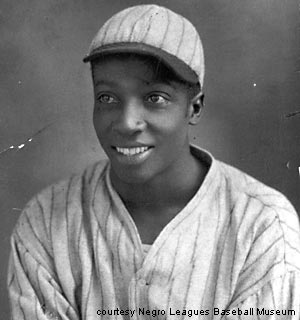
1937 Santo Domingo Dragons: This is the first team in the Cloverland Leagues that is... nontraditional, shall we say? This is based on a real-life Negro League all-star team that played in the Dominican Republic in a league organized by Trujillo. I'm not sure quite how this'll all work out- the players were grabbed from other teams (in the game sense, I mean, though in real life too), and they might be normalized oddly. But this is a game, I guess, so we'll just give it a shot. I suppose they might do extremely well, but I'd bet they'll be first-division but out of the playoffs. I guess it'll depend on what division they're in. If I go with chronologically-based
divisions, they'd probably end up with the '39 Yankees, '40 Tigers and '30 Athletics? Or the '58 A's? Potentially a very tough division, regardless. But with Satchel Paige, Josh Gibson, and Cool Papa Bell, the upside is very high...
The Dragons are the team that would likely be punted if things change, though it'll depend on the change. If the Brewers have an amazing season in 2008, the '82 team might drop out and a putative '08 team show up in the NL. I'm debating whether the would-be Fremont A's will count as separate from the Oakland version. It may depend heavily on what they call themselves. This expansion will leave only the Devil Rays as an unrepresented long-term team. A good season from them in '08 might put them in Season 4. Or it might lead me to wait, in anticipation of a better Rays team by the time of Season 5...
1982 Milwaukee Brewers: Pretty much a toss-up between this team and the 1992 team, which consistently finished at or near the top of the qualification leagues by beating up on lesser Brewer teams. I finally played a 1600 game season between these two teams, which Harvey's Wallbangers won by a handful of games. On that basis, plus the relative merits of Yount, Molitor, Simmons, Fingers, Cooper, and Thomas vs. Yount, Molitor... um... Listach? Vaughn? It was an easy call. This team will probably get slaughtered when the season rolls around, but I don't think it'll be worse than the 1992 team would have done. Besides, the 1982 team won the pennant.
1969 Washington Senators: This team did not win the pennant. They finished 4th, a distant 23 games back. However, they did win 86 games, the only time this franchise was over .500 during their tenure in the District. Frank Howard was the big star, Ted Williams the manager. The Senators regressed the following year, and were in Texas shortly thereafter. I expect these guys to get slaughtered as well.
1958 Kansas City Athletics: Slaughter, that's where this team is going to be a Viking. Seventh place in real life, witha .474 winning percentage. But they're the best of the Kansas City A's franchise, and that franchise had a 13-year lifetime, plenty long enough to deserve representation. This is something of an experiment, just to see how such a team would do. They might be replaced in Season 5 with a KC A's all-star squad, but that's looking pretty far ahead. Bob Cerv was the big hitter for this team, which I suppose did finish closer to first place in terms of games behind than the Senators above did.
1937 Santo Domingo Dragons: This is the first team in the Cloverland Leagues that is... nontraditional, shall we say? This is based on a real-life Negro League all-star team that played in the Dominican Republic in a league organized by Trujillo. I'm not sure quite how this'll all work out- the players were grabbed from other teams (in the game sense, I mean, though in real life too), and they might be normalized oddly. But this is a game, I guess, so we'll just give it a shot. I suppose they might do extremely well, but I'd bet they'll be first-division but out of the playoffs. I guess it'll depend on what division they're in. If I go with chronologically-based
divisions, they'd probably end up with the '39 Yankees, '40 Tigers and '30 Athletics? Or the '58 A's? Potentially a very tough division, regardless. But with Satchel Paige, Josh Gibson, and Cool Papa Bell, the upside is very high...
The Dragons are the team that would likely be punted if things change, though it'll depend on the change. If the Brewers have an amazing season in 2008, the '82 team might drop out and a putative '08 team show up in the NL. I'm debating whether the would-be Fremont A's will count as separate from the Oakland version. It may depend heavily on what they call themselves. This expansion will leave only the Devil Rays as an unrepresented long-term team. A good season from them in '08 might put them in Season 4. Or it might lead me to wait, in anticipation of a better Rays team by the time of Season 5...
Sunday, October 28, 2007
Championship Series, Game 3
The action shifts to West Side Park in Chicago for Game 3 of the Series. Ron Santo was on hand to throw out the ceremonial first pitch after a brief rain delay, and the Old Styles were flowing. Knotted at a game a piece, the question remains as to which of these star-crossed franchises would provide this year's championship team.
Jack Pfiester took the hill for the Cubs, while Cleveland sent Charles Nagy to the mound, a move precipitated by the loss of Claude Ogea to injury during the ALCS. Indians fans prepared for the worst, as Nagy's regular season record did not give much cause for optimism (11-13, 4.67).
Cleveland struck first in the top of the 2nd as Manny Ramirez (there he is again) singled, moved to second on a fielder's choice, and scored on a throwing error by Joe Tinker. Pfiester bore down after that, but Nagy was pitching the game of his life, throwing 6 2-hit, shutout innings against the National League champions before being lifted for a pinch hitter. In the 8th, Albert Belle hit his first home run of the postseason, giving Cleveland a bit more breathing room.
They would need that breathing room. Chicago threatened against Poole in the 8th, putting two on by a walk to Slagle and a double by Tinker with one out before Solly Hoffman pinch hit for Pfiester. Hoffman sent the ball in the air to right, deep but not quite deep enough as Belle gave the Indians another baserunner kill to end the Cubs threat (and put the West Side Grounds into a stupor). In the 9th, Jose Mesa came on and got two quick outs before a single and miscue by Belle put Frank Chance on 2nd. Steinfeldt's single put the score at 2-1 with Cubs slugger Kling at bat, but Mesa managed to strike him out for the win.
The win put Cleveland up 2 games to 1 in the best-of-seven series. Game 4 will feature a rematch of Game 1's starters-- Ruelbach vs. Martinez.
Jack Pfiester took the hill for the Cubs, while Cleveland sent Charles Nagy to the mound, a move precipitated by the loss of Claude Ogea to injury during the ALCS. Indians fans prepared for the worst, as Nagy's regular season record did not give much cause for optimism (11-13, 4.67).
Cleveland struck first in the top of the 2nd as Manny Ramirez (there he is again) singled, moved to second on a fielder's choice, and scored on a throwing error by Joe Tinker. Pfiester bore down after that, but Nagy was pitching the game of his life, throwing 6 2-hit, shutout innings against the National League champions before being lifted for a pinch hitter. In the 8th, Albert Belle hit his first home run of the postseason, giving Cleveland a bit more breathing room.
They would need that breathing room. Chicago threatened against Poole in the 8th, putting two on by a walk to Slagle and a double by Tinker with one out before Solly Hoffman pinch hit for Pfiester. Hoffman sent the ball in the air to right, deep but not quite deep enough as Belle gave the Indians another baserunner kill to end the Cubs threat (and put the West Side Grounds into a stupor). In the 9th, Jose Mesa came on and got two quick outs before a single and miscue by Belle put Frank Chance on 2nd. Steinfeldt's single put the score at 2-1 with Cubs slugger Kling at bat, but Mesa managed to strike him out for the win.
The win put Cleveland up 2 games to 1 in the best-of-seven series. Game 4 will feature a rematch of Game 1's starters-- Ruelbach vs. Martinez.
Friday, October 26, 2007
Season 4 Expansion Teams:NL
Looking ahead to next season (whenever that will be-- sometime in 2008?), each league will add 4 more teams. I'll probably go with four divisions per league of five teams each, with two rounds of playoffs, but I haven't ruled out five divisions of four teams each, with a wild card and an extra round of playoffs.
The franchises represented here were relatively obvious teams to add. The specific teams were decided in the "usual" way, having all the candidates play one another in a qualification league. Still, one very team snuck in here at the end...
2007 Rockies: Before this month, it was looking like the 2000 team would be Colorado's entry. Though they finished a pretty mediocre 4th, they had the best run differential of any Rockies team. Happily, the current team came along, and in a head-to-head set of ~40 games they handily dispatched the 2000 entry. You know all about these guys. I don't know that they've got much of a chance (depending on the division they're in, I guess), but they're certainly not an embarrassment by any means.
1997 Marlins: World Series winners. They and the 2003 team were really the only competition for the Florida slot, and this team pulled it out. I wasn't a fan of either team, but I guess less Josh Beckett in the Cloverland Leagues is fine with me.
1999 Diamondbacks: Again, a happy acccident that Curt Schilling isn't around, though he's on the 1993 Phillies already. The 1999 team, only the second year for Arizona, stormed to their best record in the desert with over 100 wins (and even more expected). They lost in the playoffs but Randy Johnson had a great year. This is one of only two teams in the league that I've seen in person, the other being the 1986 Mets...
1896 Orioles: One of the most famous 19th century teams, and perhaps the only team in this group with a chance to win it all. They were the rivals of the Beaneaters, and are likely to end up in a killer division with Boston, Chicago, Pittsburgh and the New York Giants. Often considered the greatest team of all time (pre-1927 Yankees), this team was the last to bring a championship to Baltimore for 70 years.
Barring something crazy, these should be the teams added. There only a few other possibilities: the 1895 Cleveland Spiders, though the teams already present above trump them. If the Washington Nationals have an amazing season, they could displace somebody (Baltimore?). An amazing Milwaukee Brewers season could also do it, though that would cause issues for the American League... Finally, any moves on the part of the Marlins followed by an excellent season could cause their entrance, though all of these possibilities require me to be pretty pokey in getting things underway. Of course, that's a serious possibility...
The franchises represented here were relatively obvious teams to add. The specific teams were decided in the "usual" way, having all the candidates play one another in a qualification league. Still, one very team snuck in here at the end...
2007 Rockies: Before this month, it was looking like the 2000 team would be Colorado's entry. Though they finished a pretty mediocre 4th, they had the best run differential of any Rockies team. Happily, the current team came along, and in a head-to-head set of ~40 games they handily dispatched the 2000 entry. You know all about these guys. I don't know that they've got much of a chance (depending on the division they're in, I guess), but they're certainly not an embarrassment by any means.
1997 Marlins: World Series winners. They and the 2003 team were really the only competition for the Florida slot, and this team pulled it out. I wasn't a fan of either team, but I guess less Josh Beckett in the Cloverland Leagues is fine with me.
1999 Diamondbacks: Again, a happy acccident that Curt Schilling isn't around, though he's on the 1993 Phillies already. The 1999 team, only the second year for Arizona, stormed to their best record in the desert with over 100 wins (and even more expected). They lost in the playoffs but Randy Johnson had a great year. This is one of only two teams in the league that I've seen in person, the other being the 1986 Mets...
1896 Orioles: One of the most famous 19th century teams, and perhaps the only team in this group with a chance to win it all. They were the rivals of the Beaneaters, and are likely to end up in a killer division with Boston, Chicago, Pittsburgh and the New York Giants. Often considered the greatest team of all time (pre-1927 Yankees), this team was the last to bring a championship to Baltimore for 70 years.
Barring something crazy, these should be the teams added. There only a few other possibilities: the 1895 Cleveland Spiders, though the teams already present above trump them. If the Washington Nationals have an amazing season, they could displace somebody (Baltimore?). An amazing Milwaukee Brewers season could also do it, though that would cause issues for the American League... Finally, any moves on the part of the Marlins followed by an excellent season could cause their entrance, though all of these possibilities require me to be pretty pokey in getting things underway. Of course, that's a serious possibility...
Subscribe to:
Posts (Atom)