Thursday, March 26, 2020

Cloverland Leagues: AL Central


On we go to the AL Central. It's a bit of a funny grouping.


1982 Milwaukee Brewers: Harvey's Wallbangers! They won 95 games in real life, close to their Pythagorean projection of 96. The 1978-1983 period was really the only period of sustained success in franchise history. A couple of more recent teams (2011 and 2018) won 96 games, but had worse predicted records. Besides, when push comes to shove, how do you not go with these guys?


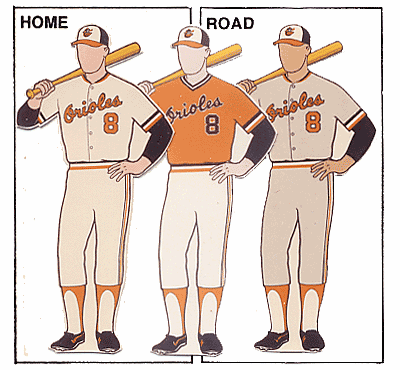
1984 Detroit Tigers: I wasn't quite old enough to be a baseball fan when the Big Red Machine was active, so this was the first team I remember that was touted as one of the all-time greats. And here it is. They outplayed their Pythagorean record by a few games, but are still pretty handily the best Tigers team of the past 50 years (but not the past 52). 


1994 Chicago White Sox: A strike victim, they were on a 96-win pace (with a 98-win Pythagorean projection) but of course got nothing. Frank Thomas had a monster year. I kind of feel like they're going to get killed in this league, but maybe not as badly as I feel like the Brewers will..


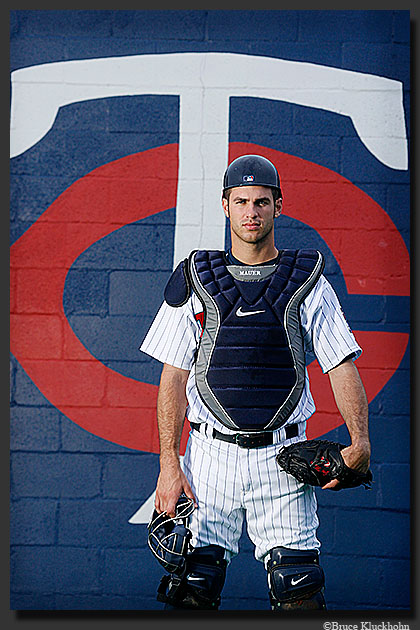
2019 Minnesota Twins: A 101-win team, and easily the best Pythagorean record of any Twins team since 1969, but damned if I could tell you anything about them (even though they're the most recent team in the league). The Yankees beat them in the playoffs, because of course the Yankees beat them in the playoffs. I suppose I'll learn more about them as the season goes on!


Wednesday, March 25, 2020

Cloverland Leagues: AL Northeast Division


So, I'm going to keep the Cloverland Leagues moniker, at least for now. As noted, I'm going to go through the teams and say a bit about each of them, starting with the AL's Northeast Division:


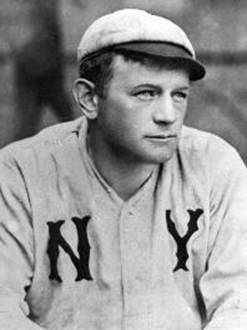
1998 New York Yankees:  Won 114 games during the regular season, which was an American League record to that point (the current record holder is in the AL West in this game), and went on to win the World Series. As a Yankees fan I'm rooting for them and will be managing them. At the time it was claimed that even though they were among the all-time greats they didn't have any Hall of Famers, but of course Jeter and Rivera proved that wrong.


2015 Toronto Blue Jays: Winners of only 93 games during the regular season, they scored and prevented runs at a clip that "should" have won them 101 games (i.e. their "Pythagorean record"). That's the best in Blue Jays history, and that's the metric we're using, so here they are. They also were involved in perhaps the single craziest inning I have ever seen in my 40+ years of baseball fandom. Josh Donaldson, Edwin Encarnacion, and Jose Bautista lead the hitters, and David Price makes his first appearance among the pitchers.  We'll see if they can keep out of 4th in this division.


2017 Cleveland Blues: I noted the name change in the last post. This team won 102 games in the regular season, but had an even better Pythagorean record (predicting 107.5 wins). This is another Edwin Encarnacion team--even given the sort-of compressed timeframe of this league I'm surprised at how many people show up on multiple "best-of" teams. Perhaps I'm used to the long tenures of the best recent Yankees? Or not acclimated to the late summer shuffle of good players from contending teams to non-contending ones?


2018 Boston Red Sox: Another recent team. This one is considered by a lot of folks to be not only the best Red Sox team of the last ~50 years, but the best of all time. In the old APBA game I used the 1912 Red Sox, it would be interesting to play them against one another (though perhaps hard to have a single group of game settings that could fairly apply to them both).  David Price makes his main appearance here, though I think he shows up on yet one other team. Mookie Betts was the superstar, of course...

Next up, we'll go to the AL Central.

Sunday, March 22, 2020

Social Distancing and New (Baseball) Beginnings


Well!  It's been quite some time since I've updated this blog, and what a decade the teens were, eh? Whoo. I never got terribly far with the last league--I didn't have time to really learn a new game and make it do what I wanted, so I used a quickstart that was available rather than trying to replicate the kind of leagues that I wrote about earlier in this blog's history.  Eventually that petered out, though I don't remember whether it was work and travel ramping up or if other things just took up my free time.

With the COVID-19 pandemic currently underway and affecting sports around the world, including the start (and perhaps the entirety) of the Major League Baseball season, I thought I'd give this another go. Technology has advanced, and while my free time is structured very differently than it was when I was last successful at running a league like this, I'm game to give it a go.

I'm using Out of the Park Baseball, the newly-released version 21. Rather than try to continue with what I was doing before, I'm basically rebooting. I'm using the best edition of each current team in the DH era, as determined by Pythagorean record (rather than real record). This is mostly for ease and so I don't have to deal with what's "fair" when the 1927 Yankees play the 1995 Indians (for instance). It turns out both the Astros and the Brewers have had their best seasons while in the AL, so the AL has 16 teams and the NL would have 14. To bring the NL up to a more aesthetic (to me) 16 teams, I've added the 1994 Expos (the Expos' move is the only relocation of the era) and a more fantastical choice, pretending that the Marlins moved to Charlotte in ~2006 or so and adding a "Charlotte Knights" team that's really the 2008 Marlins in different uniforms. They won't be competitive for the title or anything, so it shouldn't throw things off very much (I'm using a balanced schedule). It also seems like it'll be an interesting (perhaps only to me) experiment of how a not-great-but-decent team does when facing all-timers every day.

I did two other things of some (though perhaps little) note: I broke the DH-era rule for the Pirates and included the 1972 team. They're a bit better than any other Pirates team in the DH era, it's only off by a year, and that way Roberto Clemente can be included. Finally (I think), I rebranded the Cleveland team to be the Blues, one of the original names for the AL franchise. I figured since I objected to their current name (a feeling which has evolved over the decade this blog has been on hiatus) and I could do something about it, I would.

The next few posts will talk about the teams in each league. I certainly plan to have the time until that post be much less than the time taken from the previous test to this one. 

Tuesday, November 30, 2010

Game On?

I decided, after some deliberation, to move into the 21st century in terms of the baseball gaming.  Seriously.  I've been playing APBA Baseball for Windows, which has been fun but was a Windows 95 game.  I've dragged it around from our old Windows 95 machine to my rootin'-tootin' dual-bootin' Dell running Windows 2000, to Virtual PC running on my ol' PowerMac.  That was where the problems started, and it's only gotten worse since getting my MacBook Pro.  I'm not interested in installing Parallels or Boot Camp or whatever it is-- I managed to avoid a whole bunch of tsuris at work because I didn't have even a virtual Microsoft machine on here when they got hit with a major cyberattack.  So to play the game I'd have to either play on the old machine (which was already problematic) or, the lazy option I usually would pick, would use a VNC connection to the old machine and play it that way.  But I...well, I don't digress but I'm clearly going on too long.  The game isn't abandonware, but neither has an upgrade or new version been made since 1997, despite sporadic hope. 

So I've decided to try Out of The Park Baseball (OOTP).  I've been messing around for a few weeks, playing an All-Time All-Star League that was available on the web.  So far so good, I'll post about that soon.  I'm not exactly sure that I'll have a 1:1 correspondence with the games/simulations I was doing with the old game, but so it goes...

Sunday, January 24, 2010

Northeast Corridor

Recent and upcoming action centers on the Acela route. I mentioned Baltimore in the last post. The Boston Red Sox play-in is finished, and the 1948, 1949, 1995, and 2003 teams join the 12 Red Sox pennant winners in the qualification league, which I'll start... well, I'm not sure. Sometime soon? I'm still debating which team to manage, I'm leaning toward one of the Babe Ruth-era teams.

Over in the NL, I'm also setting up the Mets QL. Once again, should start soon. I'm less certain which team to manage here-- maybe 1969? Or maybe 1999. Finally, the Phillies QL is underway. At a bit over the 1/3 mark (I'm playing them to 180 games), the 1980 Phils are holding a 3.5 game lead over the 1978 team, with 1901 and 1976 another couple of games further back. I'm not sure who I was expecting, exactly. The teams with the best winning percentage in modern Phillies history are 1976 and 1977, the latter team is in 15th place (out of 16). The current dynasty of 2007-2009 are in 12th, 13th, and 14th. In case you're curious, Gene Mauch won't have to worry about a late choke in this league-- the 1964 Phils are deep in last place.

Sunday, January 17, 2010

Back in yon saddle (or '69, dude!)

Multiple crashes later...

We're back! We have a new router, which should work better. Home network has been messed with and is working better (knock knock knock). So I restarted up some of the leagues that have been so rudely interrupted:

For the Boston Braves, the previous state of affairs left the 1897 team well in front after 100 games. I ran through a replacement league and ended up with the 1897, 1898, and in a suprise, the 1948 teams all within a game of each other atop the league. So I ran it again. This time, as the first time, the 1897 Beaneaters held a healthy league at the end of things. So we welcome back the 1897 Beaneaters. As is the case in the Cloverland Leagues, the Beaneaters scored a ton of runs (6.5/game), but they had a league-average pitching staff this time, no mean feat when competing with dead-ball era squads like the Miracle Braves of 1914.

I also restarted the Red Sox Play-in League. At this point, I'm thinking I'll take four teams to add to the 12 teams with byes (the 12 pennant winners for the Red Sox). About halfway through, those four teams look to be 1949, 2003, 1995, and 1948.

Finally, after wrestling with the Orioles for so long, and all the crashes, I decided to just going to let the computer managers play it out. So congratulations to the 1969 Orioles, winners of 109 games (though they might have traded some of those for an extra three wins against the Mets). Here, they handily defeated their next closest rivals (from 1971 and 1970). In fact, the top four teams were all from Baltimore's early 70s dynasty, as 1973 finished fourth.

The '69ers were second in the league in runs scored (half a run per game above average), and first in ERA (0.7 of a run better than average). Jim Palmer '71 had 27 wins, and Mike Cuellar '69 led in strikeouts. On the hitting side, Eddie Murray '83 led in batting, Boog Powell '69 and Frank Robinson '66 tied for the lead with 44 home runs, with Boog's 1964 version just behind with 43.

Next up? Continuing the Red Sox play-in, and I think I'll try the Phillies. I'm pretty clearly not going to get Season 4 started before the real season begins, but that's OK. It is, after all, supposed to be fun, not work. :)

Sunday, November 22, 2009

On the Backstretch

Well, maybe that's not quite accurate. But a bit more than 90 games are done in the Orioles League, with about 60 to go. The current standings:

Team W L GB
1979 52 34 -
1969 53 38 3.5
1971 49 39 6
1997 49 40 6.5

with the other teams trailing further, all the way to the 1980 club, 21 games back. My 1966'ers have been very hot and cold, following up a 7 game win streak by losing 9 of 10 (and counting!)...
Various Boog Powells and Frank Robinsons are leading the league in the important categories. The big shock (for me) is the 1970 team languishing below .500 and probably out of the running.

As far as the Red Sox Play-in League, the top four teams will make it to the next stage. At this point, those four teams look to be the 2003, 1999, 1949, and 1972 clubs. 1977 and 1995 aren't far behind, though. 1972 was not a particularly distinguished year for the Sox (2nd place, a half-game back in a strike-shortened year in circumstances that, frankly, I don't understand), and I might expect them to drop out of the running.

Saturday, November 07, 2009

Red Sox Play-In, and Orioles Update

First! Started the Red Sox Play-In league. I've already forgotten whether I was going to take 2 or 4 teams, but that's an issue for a later date. The teams, as noted elsewhere, include the near-misses of the pre-Wild Card era (1948, 1949, 1972, 1977, 1978), most of the teams that made the playoffs but not the pennant (1988, 1990, 1995, 1999, 2003, 2005, 2008, 2009), and the only other team that finished over .600 and in 2nd place (1942). 10% of the way through, and the 1999 and 1949 teams are tied at the top.

Second! The Orioles League crept forward. The 1979'ers have a 1 game lead over the 1971 team, with 1997 and 1969 a half-game further back. The season's roughly half over.

Third! Rethinking the Rockies. The 2009 team was a good one, almost certainly at the same level as the 2007 team currently slated for inclusion. So, I'm thinking I'll run them against each other.

Friday, November 06, 2009

Where were we?

Let's see. Now that I'm probably done recording music for a little while, and crazy summer travel has slackened, and the Yankees have finished off the real season in style :) , it may be time to reconnect with stuff here. Having lost the Orioles season to the crash was something of a bummer, though, and has clearly sapped my enthusiasm for actually playing that season and managing a team. I'm now leaning toward just letting the computer finish it and moving on. In theory, I was also thinking of playing a Red Sox season and managing a team. We'll see how that goes.

Wednesday, July 29, 2009

Crash and crash

Lost the Orioles season to a crash. Restarted it and ran it on auto to get to the point where it was before. Again, another crash. Worst of all, it was my own stupidity that led to the crashes. :P

I'm going to try and pick this up again. Oddly (or perhaps as one might expect?) the third time through has tracked the original pretty well: 1969 a bit ahead of 1979, 1966 near .500. The details don't match, though. (The second time through 1969 was running away with it.)

So the question is whether to pick up and start managing where it left off (probably) or just let the computer managers finished what they started and move on (probably not). Unfortunately, I've been so swamped with things, I haven't had much time to play anyhow...

Monday, June 08, 2009

Baltimore, Boston, and Boston

Lumbering along. The Orioles league is approaching the halfway mark, with the 1969 team still holding a narrow lead over the 1979ers. Three other teams are lurking a bit further back. My 1966 squad has been playing much better, and slowly has entrenched themselves above .500.

Meanwhile, the Boston Braves Qualification League is underway. This is almost certainly a battle to be won by one of the 19th century teams; the franchise had a dynasty just before the 20th century dawned, and was almost completely inept from 1900 on. The 1897 Beaneaters, winners of the 2nd Cloverland Series, are in the lead with 1893 in second place.

After the Braves finish, I'm considering a Red Sox league. There are a great many teams worthy of consideration as best of the bunch, so I'm setting aside a bye for the 12 pennant winners they've had (from 1903-2007). The league I'm considering playing with next would be a play-in league, to select another 2 (4?) teams to join those 12. The play-in league would draw from the near-great Red Sox teams, from those that lost in a one-game playoff (1948, 1978) or just missed the playoffs (1949, 1977, 1972) to those that made the playoffs and lost in an opening round (1995, 1999, 2003, 1990...). If not these guys, I may choose to play a White Sox or Indians league.

Sunday, May 10, 2009

Twin Cities Closure

The real season has begun, and progress in the virtual leagues has been slow.  However! I have finished the Twins Qualification League and am happy to present the champions: The 2006 Minnesota Twins.  American League Central champions and winners of 96 games in real life, the 2006 team held off a late charge by the 1969 Twinkies to take the title by 3.5 games.  They were powered, as you might expect, by Johann Santana (22-5, 1.94 ERA, 250+ Ks), Joe Mauer (.385 to lead the league plus 121 RBI) and Justin Morneau (.330, 35 HR).  Harmon Killebrew had a monster year for both the 1967 and 1969 teams, but it wasn't enough.

Meanwhile, a couple of weeks of game time have passed in the Orioles League. My 1966ers have scuffled a bit and still sit a bit below .500.  The 1969 Os are 1.5 games ahead of the 1979 edition, with 1970 in 3rd.

Friday, February 06, 2009

Spirit of '69

Another two weeks of game time have passed in Baltimore, and we're past the quarter pole. The 1969 Orioles have ripped off 9 wins in a row to roar into first place, leading the 1979 team by 1.5 and 1970 by 3. My team, the 1966 Orioles, have been more or less treading water and sit at 20-22 (8 games behind).

Milt Pappas (who could forget Milt Pappas for Frank Robinson?) from the '64 edition is at a sparkling 8-2, with a surprising 1.17 ERA. My boys from '66 are making a good show of the hitting leader boards, however, with folk hero Russ Snyder batting .375 and Frank Robinson (see, you how could you forget?) leading the league with 15 home runs and 41 RBI.

Up in the Twin Cities, we're over halfway home. And here, too, the 1969ers are putting on a run. However, they have not (yet?) pulled ahead, finding themselves 1 game behind the 2004 team (with 2006 another 1.5 games back). Joe Mauer of the 2006 Twins paces the league with a very impressive .392 average, also leading in RBI. Meanwhile, Harmon Killebrew is tied with himself for the home run lead, and is also sitting a little bit further behind in third. Rafael Santana (2006) is at 14-2 with an ERA just under 2.00.

Looking ahead somewhat, the Boston Beaneaters/Braves or the San Francisco Giants will probably be the next team up after the Twinkies finish.

Saturday, January 17, 2009

Twins and Orioles update


The Twins League is roughly one-quarter done.  The 2003 team leads a bunched field, riding a 5-game winning streak with the 2004 team percentage points back and 2006 1.5 games behind. Based on the team stats, the 2006ers are looking pretty strong despite their current residence in 3rd.  Rod Carew (1967) leads the league in batting at .395, Killebrew (1967) in home runs, Brad Radke (2004) is at 6-0.

Meanwhile, up in Charm City, the 1979 Orioles are a game up on the 1970 team after 30 games, with the 1969 and 1997 teams in the next rank a few games back.  Surprisingly, the pitching for the 1970ers is underperforming, otherwise they'd be running away with things.  Mike Mussina (1997) is 6-0 with an ERA of 1.39, with Robby Alomar (1997) hitting .355.  Three players are tied for the lead in home runs.  My 1966 team is languishing in 9th (of 14), 5.5 back.  Of course, who knows how they'd be doing if not for my managing....

Saturday, December 27, 2008

Minnesota New Day Rising

The Twins League is underway (though perhaps with a Prince soundtrack rather than the Posies song quoted in the title).  Ten teams, basically in three time periods: the Killebrew era when the Twins had very good teams that couldn't quite beat better teams (like the Koufax Dodgers or the '69-'70 Orioles); the Puckett era when the Twins had decent teams with unbeatable home field advantage and regularly defeated better teams (Whitey Herzog nods sadly); the Johan Santana teams of recent vintage who mostly couldn't quite get out of the first round of the playoffs.

The 1970 team are the current representatives in the Cloverland Leagues.   About 20 games in out of 162, it's too close to call and far, far too early.  I guess I'd bet on 1965 as the best of these teams, but that doesn't always translate into success.  Still, if I have to guess a winner...

Meanwhile, the 1970 Orioles still are the leaders after roughly 25 games, but the 1979 edition has been on a tear and have closed to a half-game back.  Again way too early for real prognostication, but it may end up closer than I'd expected...

Monday, December 22, 2008

And from the Polo Grounds...

After a pretty close race, the 1911 New York Giants fought off the 1912, 1913, 1904, and 1905 editions of the 'Jints to win their qualification league and represent the New York Giants franchise.

The final standings at the top:

W L Pct. GB
1911 89 60 .597 -
1913 88 64 .579 2.5
1904 87 65 .572 3.5
1912 87 65 .572 3.5

Despite winning the World Series in a 4-game sweep, the 1954 Giants finished in 20th (that'd be last), 28.5 games back.

The hitting categories were mostly led by teams from the 1920s and 1930s, as one might expect, save for Jack Doyle of the 1894 squad sitting atop the batting average and obp categories and  just missing a .400 season (.399).  Mel Ott (1934) led in slugging and runs created, Rogers Hornsby (1927) in runs scored, George Kelly (1922) in RBI, and Bobby Thomson (1951) hit 33 shots heard 'round Kings Contrivance to edge out Ott (1936) and lead in home runs.

Pitching statistics were biased by the 1894 team, who had two pitchers starting 70%+ of their games in real life.  Those two pitchers (Amos Rusie and Jouett Meekin) both topped 30 wins.  Hall of Famer Christy Mathewson took up 4 slots in the top 10 winners and top 10 ERA, with the 1905 edition performing best: 29-10 (3rd in wins, 2nd in win pct., 1st in ERA, 4th in strikeouts).  

The 1911 team didn't have many statistical leaders, but managed to grind out the pennant by being among the team leaders in batting and pitching.  In reality they lost the World Series to the Philadelphia Athletics.  

The Orioles league has stalled out a bit (naturally, since I'm actually trying to manage one of the teams instead of letting the computer do all the work).  Not sure if the next all-computer league will be Oakland or Minnesota...

Tuesday, December 02, 2008

Giants after 90, Orioles after 20

The decision of who will right to represent the New York Giants is currently looking like it'll go down to the end. A bit over 90 games are finished, with roughly 60 to go. Five of the 20 teams are within a half-game of the top:

Team W L Pct. GB
1913 52 38 .578 -
1904 53 39 .576 -
1922 53 39 .576 -
1905 52 39 .571 0.5
1912 52 39 .571 0.5

Meanwhile, in Charm City things are a bit more separated, though it's still early:
Team W L Pct. GB
1970 15 5 .750 -
1969 12 6 .667 2.0
1960 12 7 .632 2.5
1997 10 7 .588 3.5

It seems unlikely the 1970 team will be able to keep up that pace, but there's nothing weird about them being atop the standings...

Sunday, November 23, 2008

Giant Steps

About 40% of the way through for the New York Giants league. The dead ball era teams continue their dominance, with the 1904 club leading the pack followed by the 1911, 1905, and 1912 teams all within 2 games.

Jack Doyle of the 1894 team is pacing the league with a remarkable (and way over his head) .457 average. Bill Terry's excellent .407 is second but obviously overshadowed. Bobby Thomson and Mel Ott are leading in home runs.

Christy Mathewson of various vintages is filling the pitching leaderboards, with the 1905 version at 12-1 and the 1913 version leading in ERA with 1.37.

Saturday, September 13, 2008

O's and Jints Update

Just a short one for now. The Orioles League has gotten through about two weeks of play, and the 1970 team is in the lead at a blistering 10-1. My 1966ers were barely a speed bump in their way, though they did force late inning heroics by Paul Blair of 1970 at least once. There's a bit of a bunch up behind the leaders and needless to say it's early yet.

I've gotten a bit further for the New York Giants QL. There the 1904 and 1905 teams lead the pack. Again, it's early yet. But I'll note that the current Cloverland League representatives are the 1970 Orioles and the 1905 Giants. It's rare for teams to be able to defend their places, with only the 1906 Cubs, 1927 Yankees, and 1976 Reds having done so so far (and I punted the Yanks for the 1939 edition in part just to do something different and since they'd finished "close enough"...).

Saturday, August 30, 2008

Dog Days

Alas, the playoff hopes of my real-life favorites are quickly dimming. I also have been too swamped to get too much done in the APBA leagues. I've started the Orioles QL, managing the 1966 edition. I'll post an update on that league once I've gotten through 10 games (right now it's at 7). I haven't started up the NY Giants at all.

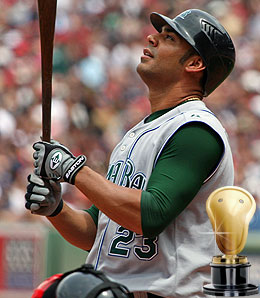
But I figured I'd mark the Rays' clinching of a winning season by officially bumping the 1937 Santo Dominigo Dragones in their favor. With 83 wins and 28 games to play, it seems likely they'll reach 90 wins with no trouble and a .500 record would net them 97. While having the Dragones meant including Satchel Paige, Josh Gibson and other greats in the Cloverland Leagues fun, my general philosophy for the simulation means I should include the team that I have a hope of including at their real relative strength instead of the one with kludged stats. The only real kind of debate would be whether holding off on Tampa Bay until Season 5 might allow a better TB team to be represented, but I can always have a runoff or something if it ends up being useful. But for now, congratulations to Scott Kazmir, Evan Longoria, Carlos Peña and the rest.

The Brewers present another problem. If the 2008 team is worthy, they could either be stuck in the AL as a non-DH team (since the majority of their seasons were as an AL franchise) or included in the NL (since they would have had this season as an NL team) with the AL version removed, or (gulp) treated as separate teams and included twice (though I don't like that option at all). If treated as an NL team, that would bump the 1896 Orioles and open space in the AL for... well, I guess the Dragones again.